Prince Moulay Abdellah Stadium is Rabat’s main large football venue and one of Morocco’s six proposed 2030 World Cup stadiums. The rebuilt ground opened for football on 5 September 2025, has an operator-listed current capacity of 68,095, and is planned to reach 68,700 gross seats for 2030.
It is a football-only bowl without the old athletics track, putting the lower stands closer to the pitch. The stadium hosted the opening match, a semifinal and the final of AFCON 2025, which ran from December 2025 into January 2026.
| Quick fact | Current answer |
|---|---|
| City | Rabat |
| Operator | SONARGES |
| Operator-listed current capacity | 68,095 |
| Planned 2030 gross capacity | 68,700 |
| Planned 2030 net capacity | 63,900 |
| Distance from central Rabat | About 7 km, according to SONARGES and CAF |
| Pitch | Hybrid natural grass |
| Football opening of rebuilt venue | 5 September 2025, Morocco vs Niger |
| 2030 role | Proposed venue; semifinal capability appears in bid planning, not a final match allocation |
Is Prince Moulay Abdellah Stadium Open?
Yes. Morocco played Niger there on 5 September 2025 in a 2026 World Cup qualifier. The Royal Moroccan Football Federation published a match-day notice for that fixture, while CAF later described it as the rebuilt stadium’s inauguration.
The venue then became Rabat’s principal AFCON 2025 ground. It staged Morocco’s group matches, knockout games and the final between Morocco and Senegal on 18 January 2026. Those completed events are stronger evidence of operating status than older construction articles.
Do not confuse the main stadium with the nearby Olympic Stadium or Prince Moulay El Hassan Stadium. Rabat used several different venues during AFCON, and a search result saying “Rabat stadium” may point to the wrong one.
Capacity: Why Do Different Numbers Appear?
Three figures circulate because sources describe different configurations:
- 68,095 is the current capacity listed by operator SONARGES.
- 68,700 gross is the planned 2030 capacity in Morocco’s official bid portfolio.
- 63,900 net is the expected tournament capacity after operational, media and other reserved areas are removed.
CAF’s AFCON venue guide also displayed 69,500 in one summary while explaining that the inaugurated venue seats 68,095 and can expand to 68,700. For planning, do not combine these numbers or assume every seat will be sold for every match. The organizer’s seating plan and security configuration determine the actual ticket inventory.
What the Real Stadium Looks Like
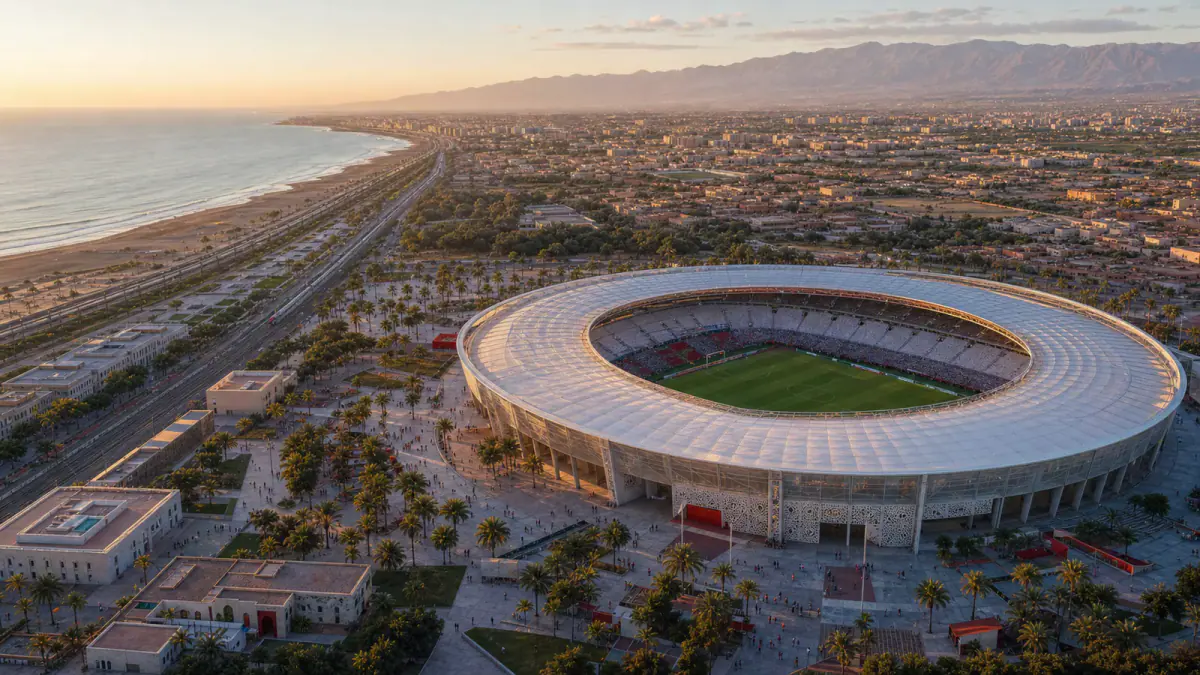
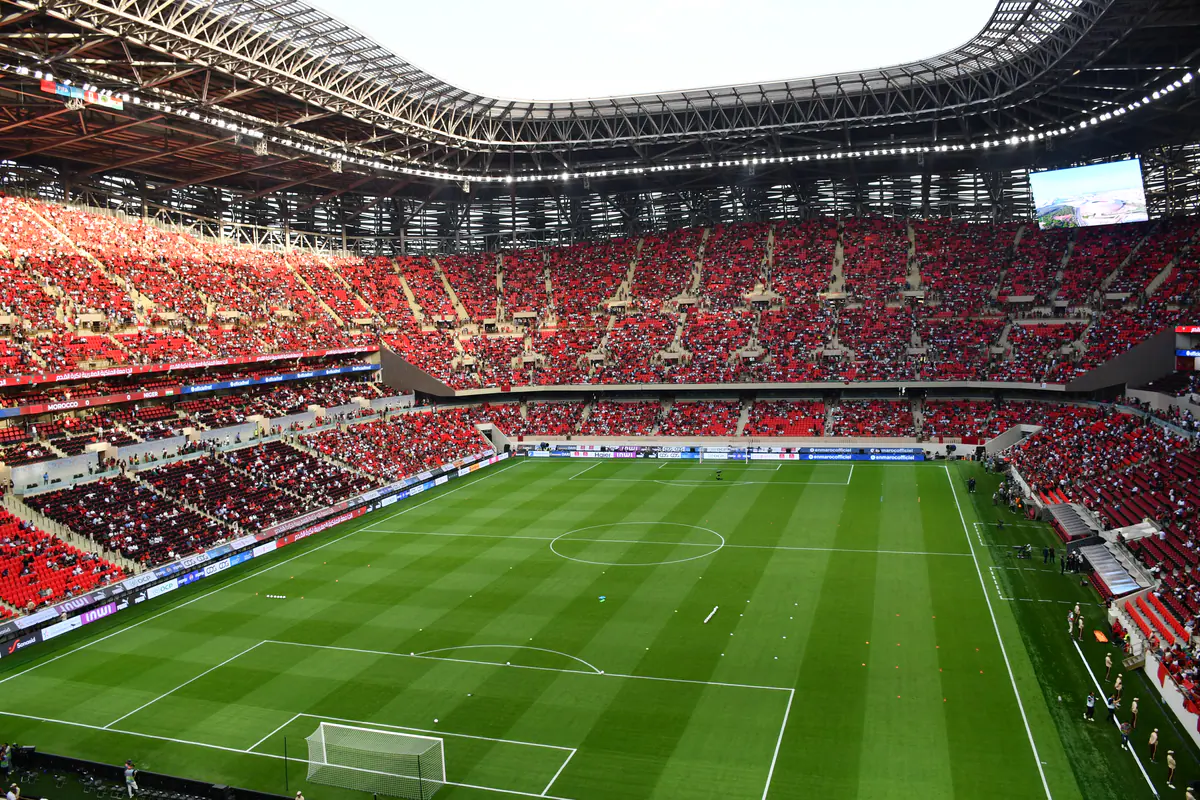
The gallery below uses documentary photographs, not renderings. The first three match-day views were taken at the Morocco–Niger qualifier on 5 September 2025. The final image records the roof and exterior structure while construction was still underway in May 2025.
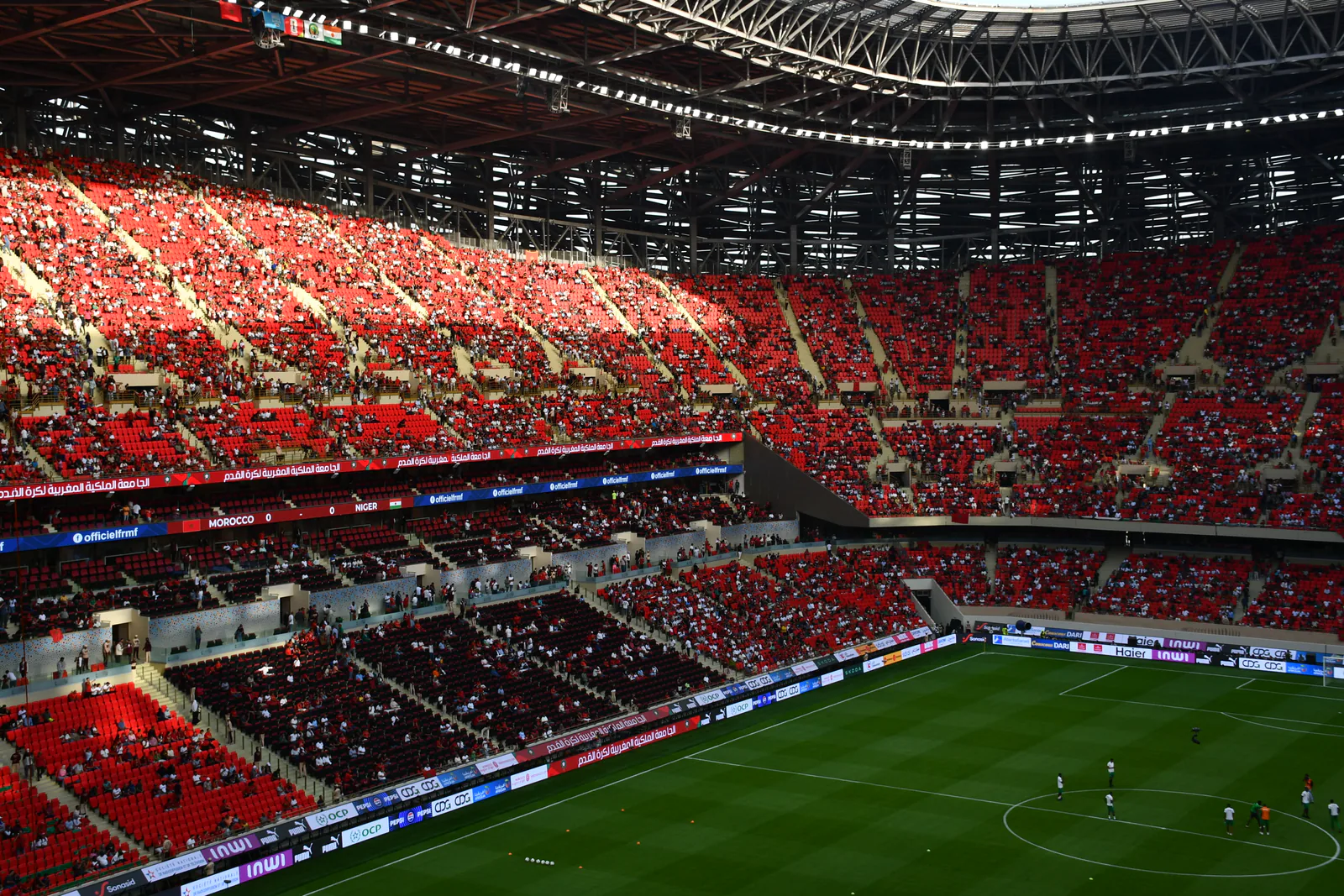
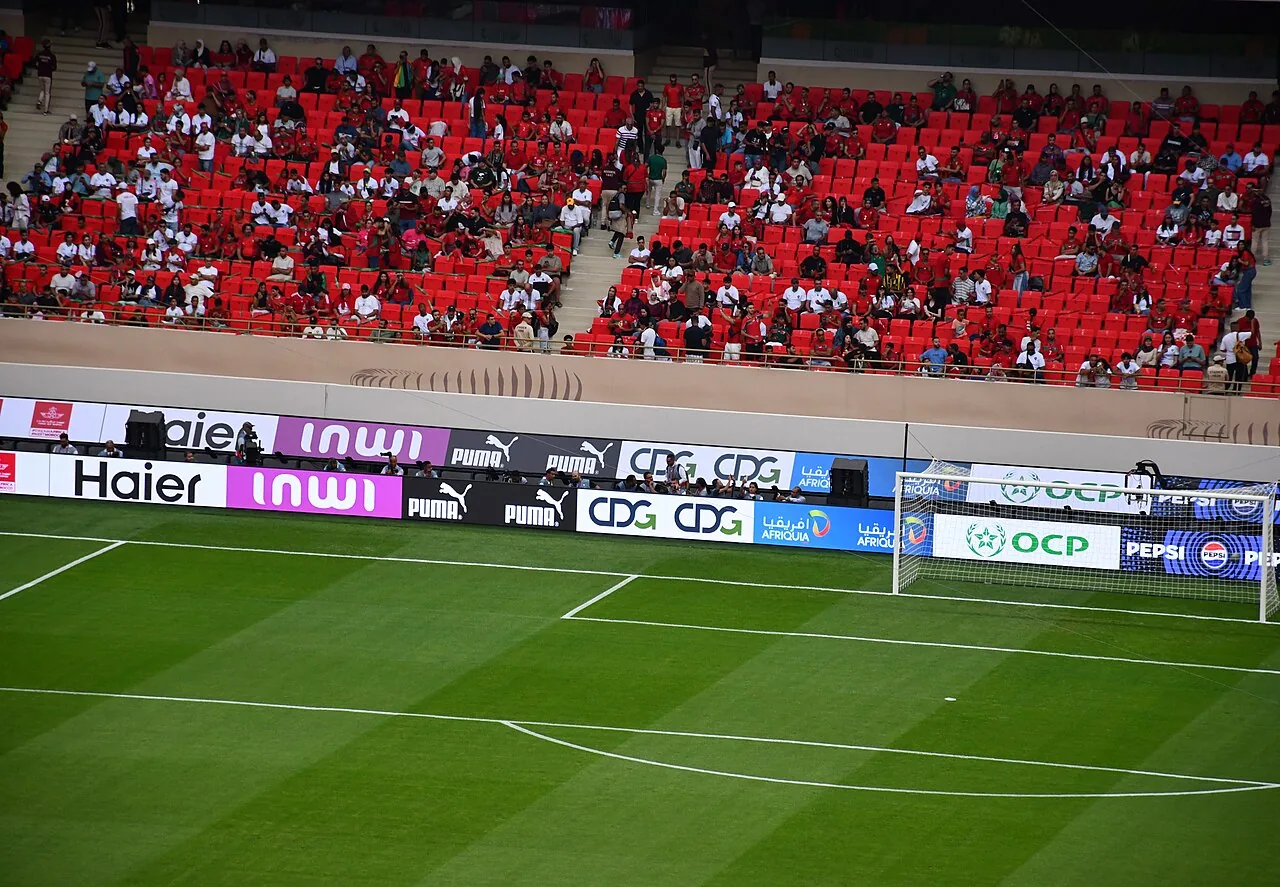
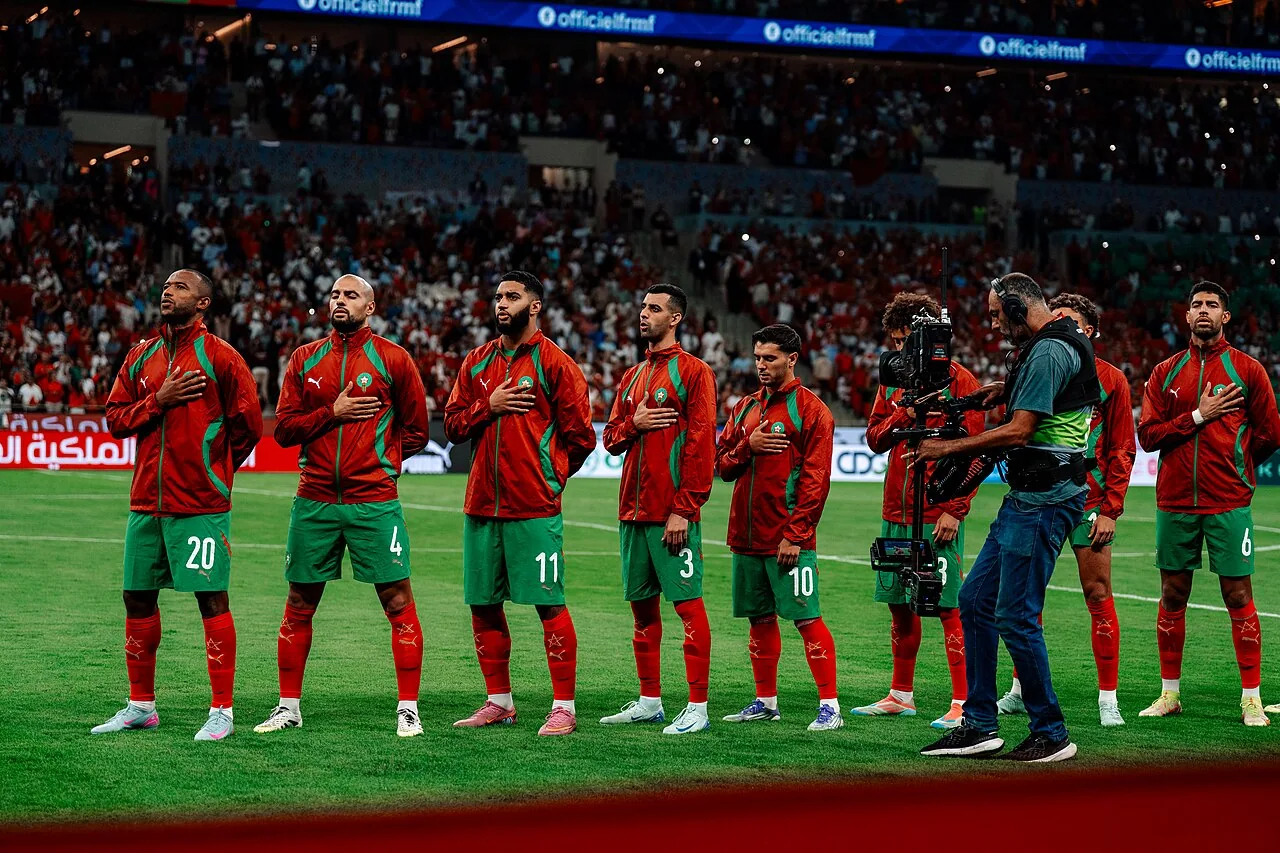
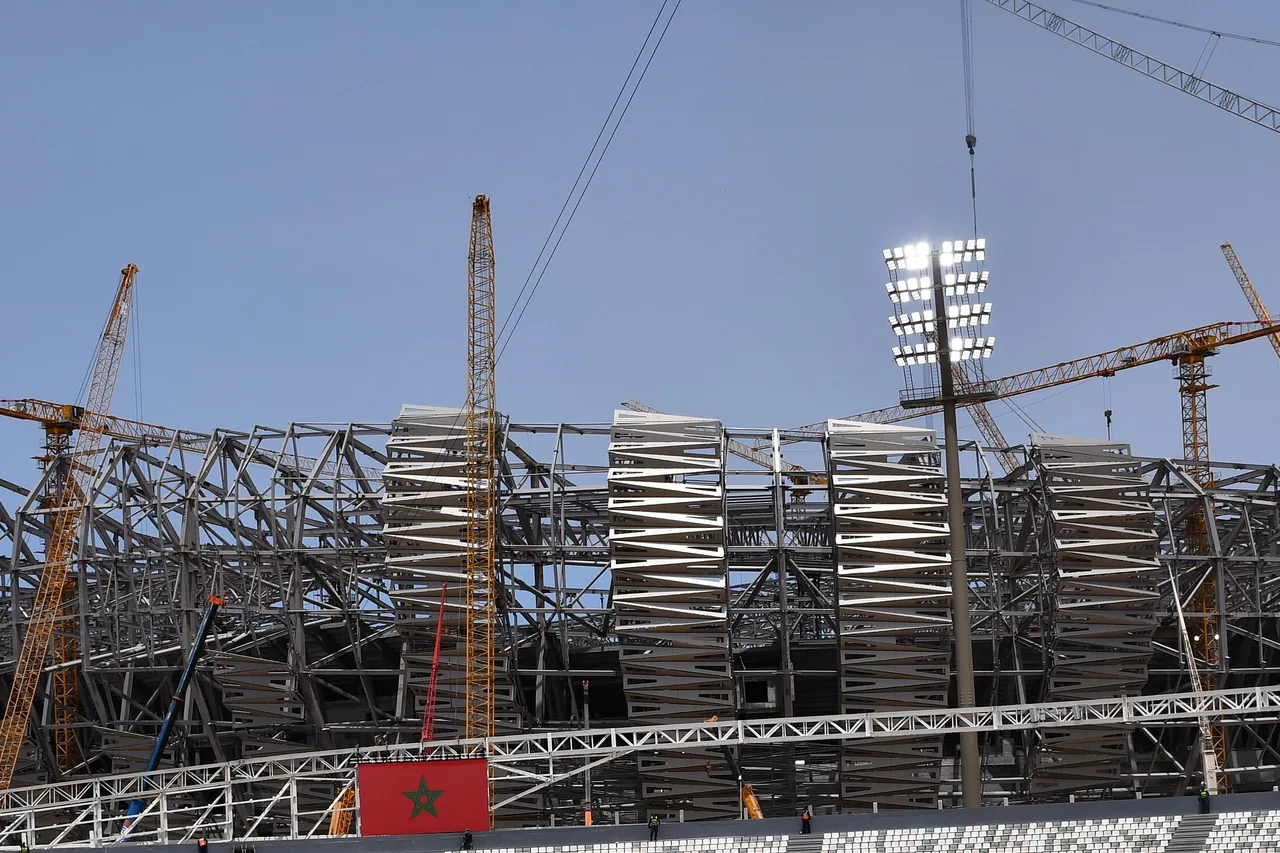
The photographs show a steep red seating bowl, an extensive roof structure and an unobstructed football pitch without an athletics track. That last point matters for spectators: it reduces the distance between the lower tier and the touchline compared with the previous multi-sport layout.
SONARGES lists a hybrid natural-grass pitch, four modern dressing rooms, two giant screens, perimeter LED displays, FIFA-standard lighting, media facilities and extensive hospitality space. These features describe the venue infrastructure; they do not guarantee what will be open to a general-admission ticket holder at a particular event.
Where Is the Stadium in Rabat?
SONARGES places the complex in the El Massira/C.Y.M. area and describes it as roughly seven kilometres from central Rabat. That is close enough to combine a match with a city stay, but not close enough to treat every central hotel as walkable to the gates.
Use the complete venue name—Complexe Sportif Prince Moulay Abdellah—when checking a map. Confirm that the pin matches the main stadium rather than the adjacent sports facilities.
For sightseeing, our Rabat guide covers Hassan Tower, the Kasbah of the Udayas, Chellah and the Atlantic waterfront. Plan the city and stadium as separate stops instead of trying to fit a major match into a tightly timed walking itinerary.
Getting There on Match Day
No permanent 2030 spectator transport plan should be treated as final yet. Shuttle routes, traffic restrictions, security perimeters and drop-off points can change by tournament and fixture.
Use this sequence for a real match:
- Read the newest organizer or federation announcement for the specific fixture.
- Check the gate-opening time, named access routes and prohibited items.
- Compare public transport, an official shuttle and a taxi using the event-day plan—not an ordinary-day estimate.
- Leave enough time to pass the outer security perimeter and then walk to the correct gate.
- Save the ticket and route instructions offline in case mobile service slows near the venue.

The federation’s notice for the September 2025 Morocco–Niger match opened the gates at 4:00 p.m. That time belongs to one completed fixture, not a standing rule for future matches. A 2030 ticket will have its own instructions.
Tickets and Entry
There is no general public ticket sale for the 2030 World Cup at the time of this source review. A website claiming to guarantee ordinary 2030 seats years in advance should not be treated as an official seller.
For current national-team or club matches:
- start from the competition organizer, federation or club announcement;
- follow only the authorized ticket link named there;
- check the stadium, date, kickoff, stand and gate before paying;
- avoid social-media screenshots and unofficial resellers;
- bring only items allowed by the fixture notice.
The main stadium often hosts Morocco’s national team and major finals, but the venue must still be confirmed for every match. Rabat has enough football grounds for a fixture to be listed in the city without being played at Prince Moulay Abdellah.
Accessibility: What the Bid Documents Say
The official 2030 bid sheet lists 329 wheelchair seats, 247 easy-access seats, 58 accessible or wheelchair toilets and 192 accessible parking places.
These are planning specifications, not a firsthand accessibility review. A supporter still needs the event organizer to confirm the accessible-ticket process, companion seating, entry gate, drop-off arrangements and step-free route for the particular match.
If you need assistance, contact the authorized ticketing or venue channel before purchase. Do not rely on a generic seating image to determine whether a route is step-free.
What Is Confirmed for the 2030 World Cup?
FIFA appointed Morocco, Portugal and Spain as the main hosts of the 2030 World Cup, with centenary celebration matches in Argentina, Paraguay and Uruguay. Morocco’s bid includes Prince Moulay Abdellah Stadium as the Rabat venue.
The bid sheet labels the stadium as capable of hosting through the semifinal stage. That is not the same as FIFA assigning a semifinal to Rabat. The exact match calendar, ticket prices, fan zones and match-day transport remain future decisions.
For the national picture, compare Rabat with the other five proposed Moroccan venues in our Morocco 2030 World Cup stadium guide. The largest planned venue is Grand Stade Hassan II near Casablanca, which is a different project and is not in Rabat.
Frequently Asked Questions
Is Prince Moulay Abdellah Stadium the national stadium of Morocco?
It is a principal home for Morocco’s national football team and a major finals venue. Match locations can still rotate, so “national stadium” should not be read as a guarantee that every Morocco home game is played there.
Does the stadium have an athletics track?
No. CAF’s venue guide says the track was removed in the rebuilt football-only arena. The nearby Olympic Stadium is a separate venue with an athletics track.
Can I tour the stadium on a non-match day?
Do not assume a regular public tour exists. The current operator information focuses on events and venue facilities. Ask SONARGES before making a special trip.
Will Rabat definitely host a 2030 semifinal?
No final match allocation has been published. Semifinal capability appears in the bid planning, but FIFA and the tournament organizers will determine the schedule.
Can I use these photos to judge my seat view?
No. The gallery documents the stadium from several viewpoints, but it does not show every section or sightline. Use the official seating plan for your fixture and section.
Final Takeaway
Prince Moulay Abdellah Stadium is already an operating major venue, not a future-only 2030 concept. Its football-only bowl, 68,095 current operator-listed capacity and record of hosting the 2026 AFCON final make it central to Morocco’s stadium network.
For a visit, keep three facts separate: the gross and net capacity figures are not interchangeable, Rabat’s proposed semifinal role is not a confirmed match assignment, and event-day access rules matter more than an ordinary map estimate.
Sources and image credits
- SONARGES: Complexe Sportif Prince Moulay Abdellah — current operator capacity, location, pitch and facilities.
- Morocco’s official 2030 stadium portfolio and Prince Moulay Abdellah bid sheet — gross/net capacity, accessibility specifications and bid-planning role.
- FIFA: World Cup 2030 tournament organization — hosts and bid documents.
- CAF: AFCON 2025 venue guide — football opening, venue configuration and AFCON role.
- FRMF: Morocco–Niger match-day notice — 5 September 2025 fixture and gate-opening notice.
- Real hero: Moulay Abdellah Stadium.jpg, Reda Benkhadra, CC BY-SA 4.0.
- Real interior: Moulay Abdellah Stadium - interior.jpg, Reda Benkhadra, CC BY-SA 4.0.
- Real goal and supporter view: World Cup 2026 Qualifiers (Morocco v Niger) 1.jpg, Reda Benkhadra, CC BY-SA 4.0.
- Real national-anthem view: Hymne national Maroc vs Niger 2.jpg, Laloumance, CC BY 4.0.
- Real construction view: Prince Moulay Abdellah Stadium, 2025.jpg, Reda Benkhadra, CC BY-SA 4.0.
Source review: 21 October 2026.