The Fes medina becomes easier when you stop trying to understand every lane. A strong first walk uses a small number of landmarks: enter at Bab Boujloud, descend through the main commercial streets, pause at Bou Inania and Nejjarine, pass the Al-Qarawiyyin and Attarine area, choose whether to add the Chouara Tanneries, then finish near Place R’cif.
This is a route, not a list of everything in Fes el-Bali. Allow a full day with lunch, or divide it into two half-days if you prefer museums and craft stops at a slower pace.
Quick answer: Start at Bab Boujloud around 9 a.m., visit Bou Inania Madrasa if open, follow Talaa Kebira toward Nejjarine, continue to the Al-Qarawiyyin and Attarine area, make an optional tannery detour, then exit toward Place R’cif. The core walk is short in distance but can take six to eight hours with visits, shopping, lunch and navigation.
Fes Medina Route at a Glance
| Stage | Main purpose | Suggested time |
|---|---|---|
| Bab Boujloud | Orientation and entry | 15 minutes |
| Bou Inania area | Madrasa architecture and water clock exterior | 45–60 minutes |
| Talaa Kebira | Markets, lanes and everyday medina rhythm | 45 minutes |
| Nejjarine | Fountain, fondouk and woodcraft museum | 60–90 minutes |
| Al-Qarawiyyin area | Spiritual and intellectual centre | 30–45 minutes |
| Attarine and Seffarine | Architecture and metalwork | 45–60 minutes |
| Chouara Tanneries | Optional leather-work viewpoint | 45–75 minutes |
| Place R’cif | Food, orientation and exit | 30 minutes |
Those times are generous. If you enter two museums, stop for lunch and buy crafts, the route fills a day. If your goal is only a guided orientation walk, use the same anchors over a half-day and return to selected interiors later.
Before the Walk
Wear shoes with grip. Fes el-Bali has slopes, polished paving, steps and wet areas around some working streets. A small day bag is easier than a wide backpack in busy passages.
Download an offline map, but do not expect perfect turn-by-turn directions. High walls can affect GPS, private passages may look public, and construction can alter a lane. Save these three fixed points:
- Bab Boujloud, where the route begins;
- Nejjarine, the middle anchor;
- Place R’cif, the practical exit.
Opening days, admission prices and restoration work change. Check the latest local information before setting out. If one monument is closed, continue the route rather than allowing a single door to define the day.
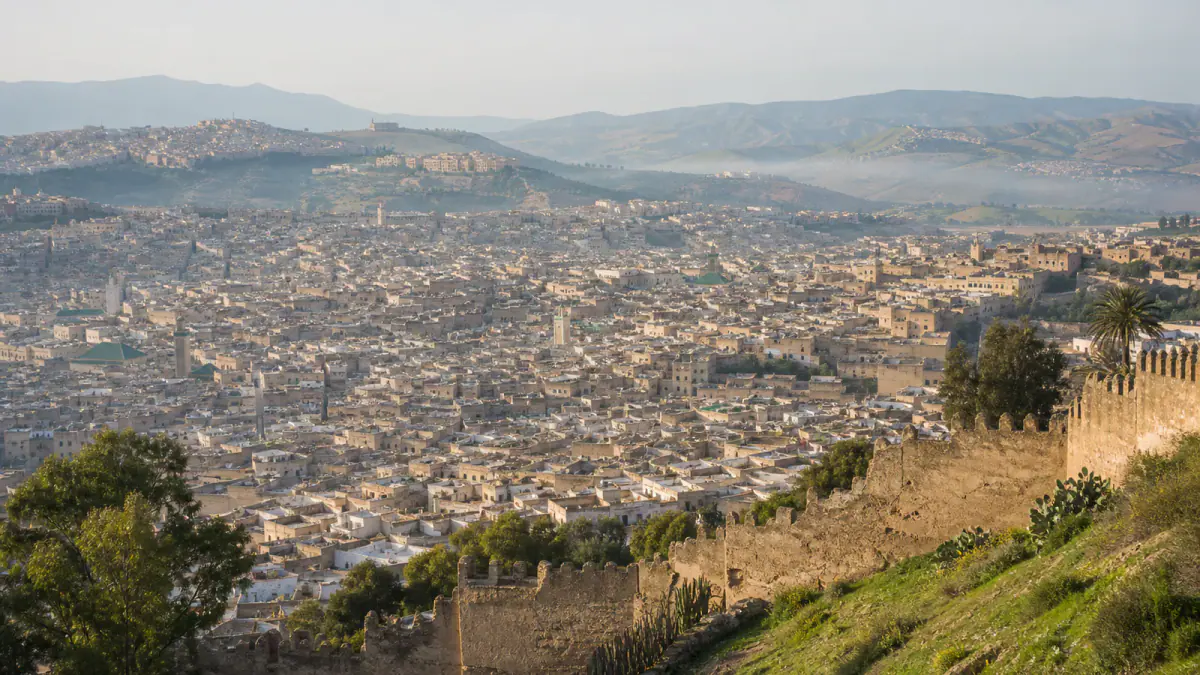
The medina is a UNESCO World Heritage Site because it preserves far more than old buildings. UNESCO’s official Medina of Fez record emphasizes its long-lived urban fabric, traditional skills and continuing social functions. Walk as a guest in a working city, not as though every doorway were a public exhibit.
1. Begin at Bab Boujloud
If you are arriving by rail, read the station-to-medina arrival guide first. This walking route begins at the gate, not at Fes train station.
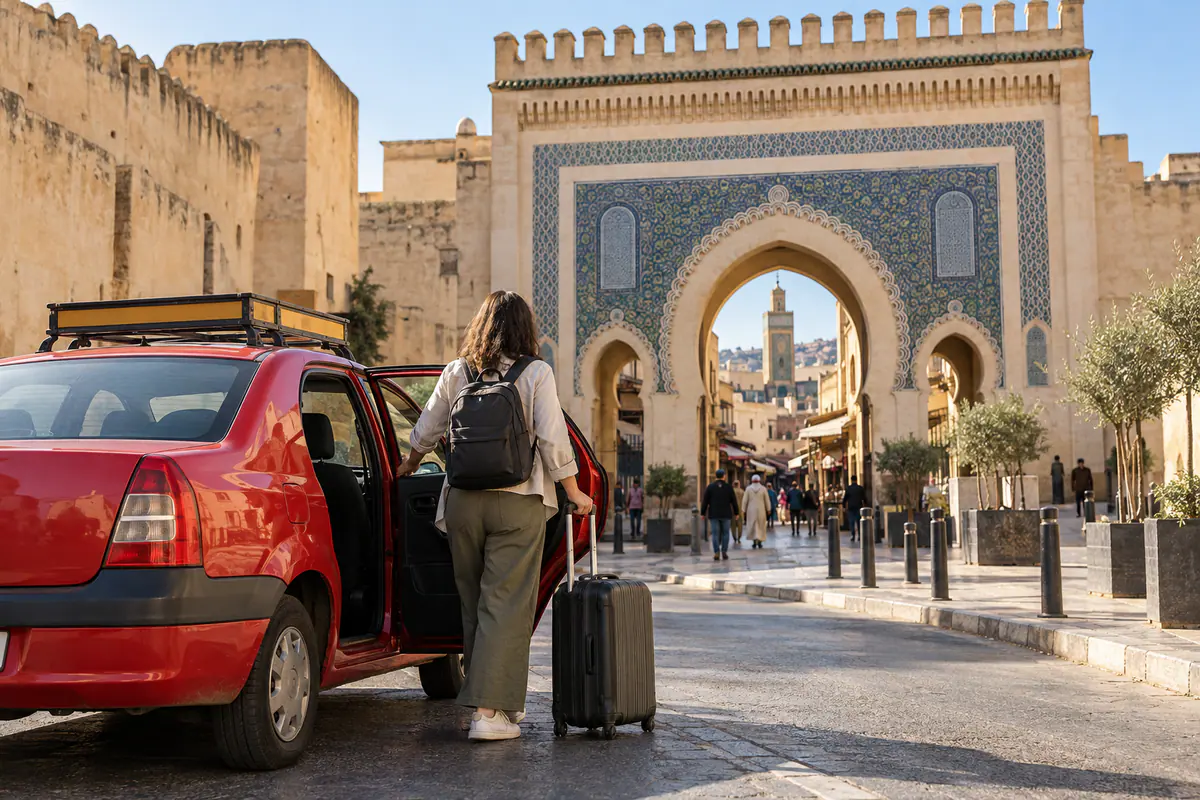
Bab Boujloud is the simplest starting gate for a first medina walk. The Moroccan National Tourist Office also identifies it as the easiest entrance on its official Fes page.
Pause before passing through. The gate helps establish direction: the denser old city drops away beyond it, while Batha and vehicle-accessible roads remain behind you. Take a screenshot of the gate area so you can recognize the return point later.
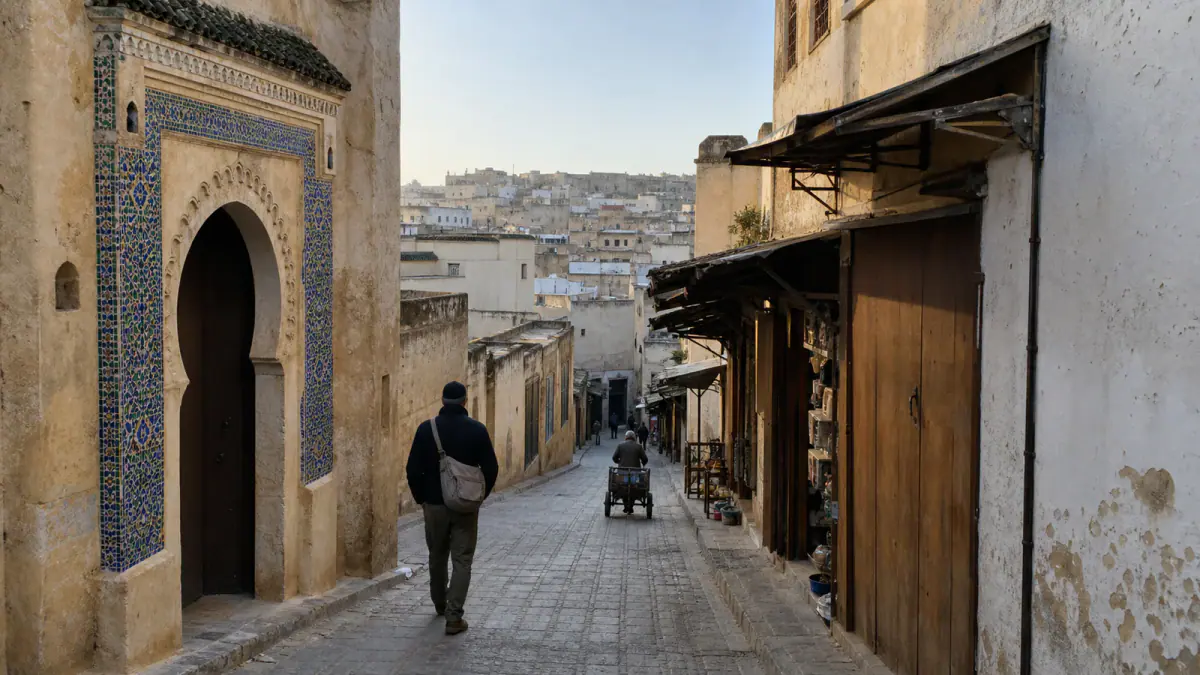
Inside, two well-known lanes descend into Fes el-Bali: Talaa Kebira and Talaa Sghira. They connect and separate at different points, and both carry food stalls, shops, guesthouses and neighborhood traffic. This route begins along Talaa Kebira because it passes Bou Inania and provides useful cultural anchors.
The first hundred meters are active and visitor-facing. Do not judge the entire medina by the restaurant menus and souvenir displays nearest the gate. The character changes as you move deeper.
2. Visit Bou Inania Madrasa If Open
Bou Inania is a valuable early stop because it introduces the visual language you will see throughout Fes: zellige at the lower level, carved plaster above, cedar wood, calligraphy and a courtyard organized around water and prayer.
It is also one of the few historic religious-school interiors commonly accessible to non-Muslim visitors when open. Access rules can change, so respect the entrance notice and staff instructions.
Do not spend the visit only taking a symmetrical doorway photograph. Look at:
- how decoration becomes finer at eye level and above;
- the relationship between the central courtyard and surrounding student spaces;
- cedar surfaces darkened by age;
- the balance between repeating geometry and handwritten calligraphy;
- how light changes from the lane to the interior.
Across the lane, the historic water-clock façade is easy to miss. Its mechanism is not functioning as an ordinary modern clock, but the surviving beams and openings provide another clue to the scholarly district around Bou Inania.
If the madrasa is closed, view the exterior respectfully and continue. Attarine Madrasa later in the route offers another chance to study Marinid-era design when accessible.
3. Follow Talaa Kebira Without Rushing
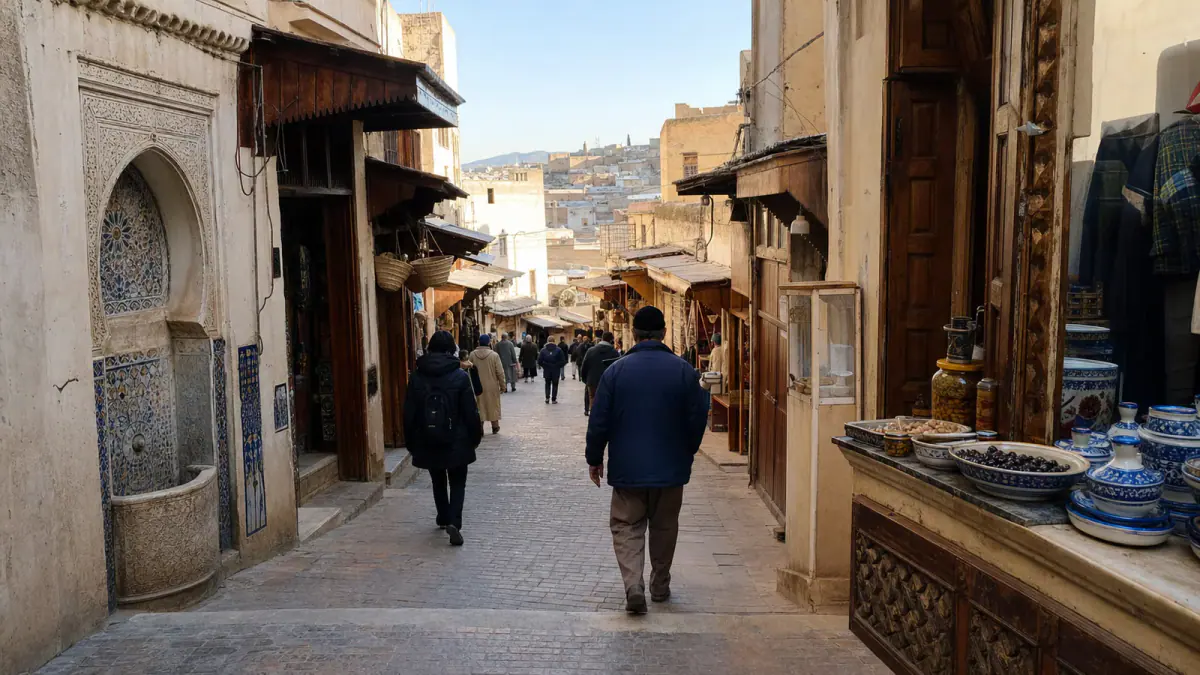
Talaa Kebira is both route and market. It descends toward the core of the medina through changing clusters of goods and services.
Keep to one side when carts, loaded animals or workers need the lane. Stop where there is space, not in the narrowest point. The medina’s pedestrian scale does not mean it is free from traffic; goods still have to reach homes and shops.
This section is useful for ordinary observations:
- bread moving between households and neighborhood ovens;
- small food counters preparing bessara or fried snacks;
- textiles and slippers displayed in vertical spaces;
- fountains built into walls;
- lanes opening briefly into small squares;
- signs pointing toward mosques, fondouks and museums.
If someone tells you the road is closed and immediately offers a private route, verify the claim. A real closure normally has a visible barrier or affects everyone. Ask a shopkeeper if uncertain.
4. Use Nejjarine as the Middle Anchor
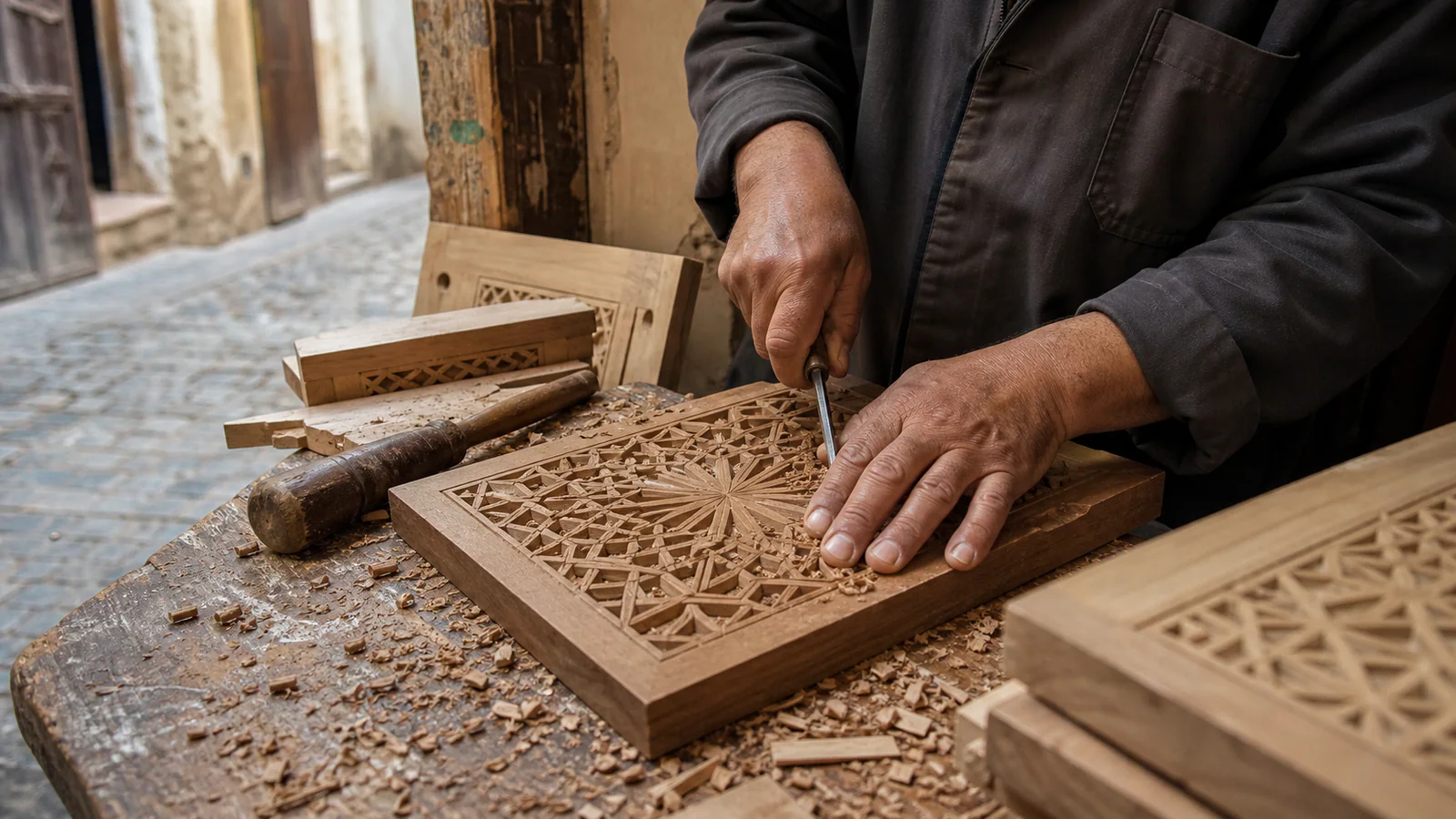
Nejjarine is one of the best places to pause because several forms of Fes heritage meet in a compact area: a decorated public fountain, a historic fondouk and a museum focused on wooden arts and crafts.
The Nejjarine Museum occupies a former caravanserai. Morocco’s tourism office describes the Nejjarine collection as including wooden handicrafts, carpentry tools, musical instruments and other objects connected to the craft history of Fes.
The building matters as much as the display. A fondouk historically served merchants, animals and stored goods around a central courtyard. As you move through it, notice the practical structure before concentrating on decoration.
The museum is a good choice if:
- the streets already feel overwhelming;
- you want context before shopping for woodwork;
- weather makes an indoor stop useful;
- you prefer material culture to another palace interior.
Allow enough time to read labels and look at tools. A collection of finished objects makes more sense when you understand the cutting, carving, joining and finishing behind them.
5. Walk Toward Al-Qarawiyyin Respectfully
The Al-Qarawiyyin area is the intellectual and spiritual heart of historic Fes. The institution’s long history is central to the city’s identity, but visitor access is not equivalent to an ordinary museum.
Non-Muslims should expect to view the mosque through accessible thresholds rather than enter prayer areas. Never block a doorway for photographs, and move aside when worshippers are entering.
The surrounding lanes are part of the experience. Book traditions, religious goods, food, fountains and dense commercial activity reflect the relationship between learning, worship and daily life.
Avoid repeating the simplified claim that one doorway alone represents “the world’s oldest university” without context. Institutions evolve across centuries. What is important for a visitor is that Al-Qarawiyyin has been a major centre of scholarship and religious life within Fes for a very long time.
This route concentrates on the spatial experience. For a deeper history of the city’s dynasties, crafts and urban development, read our separate ancient Fes guide.
6. Choose Attarine Madrasa or Seffarine Square
Attarine Madrasa sits close to the Al-Qarawiyyin area. When open, its smaller courtyard gives you another chance to examine zellige, carved plaster and cedar at close range.
If you already spent substantial time at Bou Inania, do not feel obliged to complete both. Compare them only if architecture is a main interest. Otherwise, continue toward Seffarine.
Seffarine Square is associated with metalworkers. Hammering can make the square loud, but the sound is evidence of work rather than a scheduled performance. Watch from a position that does not obstruct craftspeople or customers.
When considering a brass or copper item:
- Ask whether it is handmade, partly hand-finished or machine-produced.
- Look for even edges and stable joints.
- Ask how the surface should be cleaned.
- Consider weight and luggage before negotiating.
- Request permission before filming close-up work.
The Moroccan tourism office’s Fes medina overview identifies tanners, weavers, metalworkers and potters as part of the city’s continuing craft landscape. That continuity depends on people being able to work, not only on visitors seeing them.
7. Decide Whether to Add the Chouara Tanneries
The Chouara Tanneries are the route’s most famous optional branch. They are a real production area and a major visitor stop, viewed mainly from terraces belonging to surrounding leather shops.
Go if you want to understand part of the leather process and can tolerate strong smells. Skip it if you are sensitive to odors, uncomfortable with animal-hide production or already tired of sales interactions.
Before following anyone upstairs, ask:
- Is there a fee for the viewpoint?
- Is a shop presentation expected?
- How many flights of stairs are involved?
- Can you leave without buying?
Many terraces provide mint to hold near the nose. It can help a little, but the smell remains. The physical setting may include steep stairs and wet surfaces.
From the viewpoint, look beyond the colored vats. Notice the sequence of work, hides at different stages, drying areas and movement of materials. Avoid presenting the tannery as an untouched medieval spectacle. Tools, chemicals, labor conditions and production methods can evolve even when a craft district remains historic.
If you shop for leather, inspect the item away from dramatic lighting. Check seams, lining, hardware, odor and color transfer. A low first price does not matter if the bag is poorly made.
8. Finish at Place R’cif
Place R’cif is a useful end because it opens the route into a more legible public space with vehicle access nearby. It is easier to arrange a taxi here than from a deep interior lane.
Depending on your energy, use R’cif for:
- a simple late lunch;
- coffee or juice;
- a taxi back to Batha, the station or Ville Nouvelle;
- a short walk around the food market;
- an evening return after resting.
Save the exact pickup point. “R’cif” can refer to a broad area, and meeting a driver is easier when you share a pin.
If your accommodation is near Bab Boujloud, you do not have to retrace the entire route. Ask the riad whether taxiing from R’cif or walking back is more practical at that hour.
Where to Eat Along the Route
The easiest mistake is waiting until hunger turns every shop interaction into irritation. Plan a food break around Nejjarine, the Al-Qarawiyyin area or R’cif rather than relying on the first rooftop invitation.
For a quick meal, look for visible turnover and clear pricing. Common options include soup, grilled meats, sandwiches, fried potato cakes, olives and seasonal fruit. For a longer lunch, reserve a riad or established restaurant where the courtyard itself provides a break from the street.
Fes is closely associated with refined sweet-savory cooking, including pastilla. Not every day needs a ceremonial dish, however. A simple bowl of bessara and bread may suit a walking day better.
Our guide to traditional Moroccan dishes explains common foods and helps you order with more context.
Self-Guided or Licensed Guide?
This route can be self-guided if you are patient, use fixed anchors and accept occasional backtracking. A licensed guide adds value when you want historical context, introductions to specific crafts or efficient navigation between interiors.
A guide is especially useful for:
- travelers with only one full day;
- families managing different energy levels;
- visitors seeking a particular language;
- architecture or craft specialists;
- anyone anxious about navigation.
Before the tour, agree on duration, price, monument fees, pace and shopping. Say clearly whether you want commercial stops. A professional guide should be able to build a worthwhile route without making purchases compulsory.
For accommodation, arrival and guide-booking decisions, use our broader first-trip Fes travel guide.
Shopping Without Losing the Day
Fes offers leather, ceramics, wood, metalwork, textiles and embroidery. Looking is part of the walk, but unplanned shopping can consume the entire route.
Decide in advance whether you are browsing or seeking one specific item. For an expensive purchase:
- compare at least two sellers;
- ask what is handmade and what is assembled;
- inspect the back and inside, not only the decorated surface;
- obtain written dimensions and shipping terms;
- pay only when the full agreement is clear.
Calm bargaining is normal in many shops. Mockery, aggressive low offers and performative arguments are not necessary. If the price remains wrong, thank the seller and leave.
Photography and Medina Etiquette
Ask before photographing a person, even when the background is beautiful. Ask again before close-up video in a workshop. A purchase does not automatically buy portrait rights.
Do not photograph through residential doors or into prayer areas. Keep cameras away from children unless a parent gives clear permission. Around the tanneries, follow safety instructions and avoid leaning equipment over a low edge.
Dress comfortably and respectfully. There is no need to imitate local clothing. Shoulders and knees covered are a practical baseline around religious districts, and a light layer helps in cool interiors.
Accessibility and Sensory Load
Fes el-Bali is difficult for many mobility needs. The route includes slopes, steps, narrow passages and uneven surfaces. Museums may occupy historic buildings without elevators.
Travelers with limited mobility should contact individual sites and arrange a custom route beginning at the most accessible gate. A shorter visit near Batha, Bab Boujloud or R’cif may be more successful than attempting the full line.
The medina can also be intense for visitors sensitive to noise, crowds or odors. Begin early, schedule a quiet indoor break and treat the tannery as optional. There is no prize for enduring an experience that makes the rest of the day miserable.
Common Route Mistakes
Trying to see every monument
Two well-observed interiors are better than six rushed doors. Choose Bou Inania or Attarine, then decide whether Nejjarine adds something different.
Entering the tannery without asking questions
Clarify viewpoint access and shop expectations before climbing.
Depending on live GPS
Save fixed gates and squares. Use the map to confirm broad direction, not every meter.
Blocking working lanes
Move to the side before checking a phone or composing a photograph.
Starting too late
A morning start gives more time for opening hours, navigation and a daylight exit.
Treating getting lost as mandatory
Small detours can be enjoyable. Anxiety, darkness and missed bookings are not. Ask for help and use known anchors.
Frequently Asked Questions
How long does this Fes medina route take?
Allow six to eight hours with two interiors, lunch and the tanneries. A guided orientation version can take three to four hours.
Is the route downhill?
Much of the direction from Bab Boujloud toward R’cif descends, but the medina still contains steps, short climbs and uneven passages. The route is not step-free.
Can I enter Al-Qarawiyyin?
Access depends on the area and the visitor. Non-Muslims should expect mosque prayer spaces to be closed and must follow signs and staff instructions.
Is the Chouara Tannery free?
Viewpoints are often reached through private leather shops. Expectations vary. Ask about any charge or presentation before going upstairs.
Is Fes medina safe without a guide?
Many visitors walk independently. Use normal city awareness, begin in daylight, keep valuables controlled and use recognized gates. A licensed guide is helpful for context and efficiency, not an absolute requirement.
Which spelling is correct: Fes or Fez?
Both are common English spellings; “Fès” is also used. They refer to the same city.
Final Takeaway
A first Fes medina day needs structure, not speed. Bab Boujloud, Bou Inania, Nejjarine, Al-Qarawiyyin, Attarine or Seffarine, the optional tanneries and R’cif form a route that is rich without becoming impossible.
Start early, verify current openings, keep workshops functioning around you and give yourself permission to skip a stop. Fes el-Bali makes more sense when the walk has anchors—and still leaves space for the city between them.