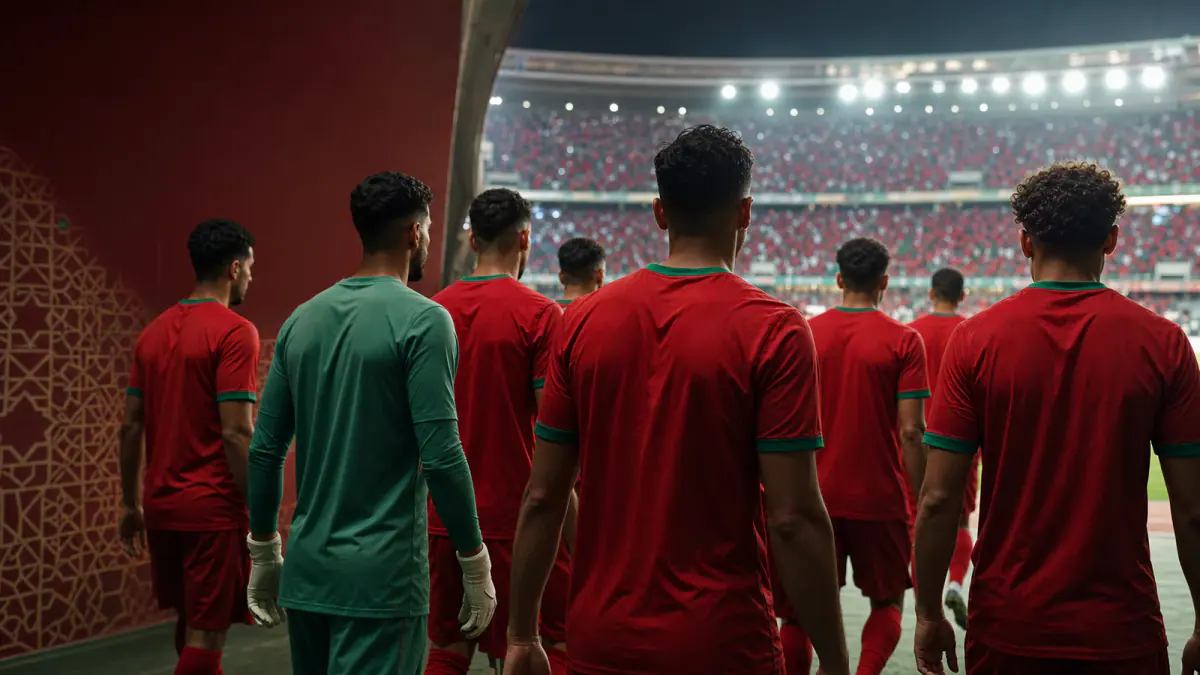
The best Moroccan football players of 2025 were not simply the eleven most famous names. Morocco’s strength came from the balance between proven leaders such as Achraf Hakimi and Yassine Bounou, reliable tournament players, and a younger group led by Brahim Diaz, Ismael Saibari and Bilal El Khannouss.
This guide looks back at the Atlas Lions squad that defined 2025. It explains who mattered, what each position group contributed and which young Moroccan footballers were pushing for larger roles. It is a historical 2025 guide, followed by a dated note explaining how the senior team changed in 2026.
Quick answer: Morocco’s standout players in 2025 included Achraf Hakimi, Yassine Bounou, Brahim Diaz, Sofyan Amrabat, Nayef Aguerd, Noussair Mazraoui, Ismael Saibari, Bilal El Khannouss, Youssef En-Nesyri and Ayoub El Kaabi. There was no single permanent starting eleven because injuries, form and opponents changed the selection.
Morocco’s 2025 Atlas Lions Squad at a Glance
The clearest official snapshot is the squad selected for AFCON 2025, staged in Morocco from December 21, 2025 to January 18, 2026. CAF’s official Morocco squad announcement listed the following players.
| Position | Players in the official AFCON 2025 selection |
|---|---|
| Goalkeepers | Munir El Kajoui, Yassine Bounou, El Mehdi Al Harrar |
| Defenders | Achraf Hakimi, Mohamed Chibi, Jawad El Yamiq, Romain Saiss, Abdelhamid Ait Boudlal, Nayef Aguerd, Adam Masina, Noussair Mazraoui, Anas Salah-Eddine |
| Midfielders | Oussama Targhalline, Sofyan Amrabat, Ismael Saibari, Neil El Aynaoui, Bilal El Khannouss, Azzedine Ounahi |
| Forwards | Brahim Diaz, Ilias Akhomach, Chemsdine Talbi, Youssef En-Nesyri, Ayoub El Kaabi, Soufiane Rahimi, Abdessamad Ezzalzouli, Eliesse Ben Seghir |
| Reserves named by CAF | Youssef Belammari, Hamza Igamane |
That list is useful as a dated record, not a live roster. International squads change from one window to the next, and club affiliations can change even faster. When checking an upcoming match, use the latest squad announcement rather than assuming every name below is currently available.
1. Achraf Hakimi: Captain and Two-Way Leader
Achraf Hakimi was the natural reference point for Morocco in 2025. Calling him a right-back describes his starting position but not the full job. He could stretch the pitch, carry the ball through pressure, attack the penalty area and recover quickly when Morocco lost possession.
His importance was also emotional. Hakimi linked the generation that reached the 2022 World Cup semi-final with the younger players entering the side. CAF’s December squad announcement noted that he was selected for AFCON despite an ankle injury because his leadership remained so valuable.
For a supporter learning the team, Hakimi is the easiest player to watch first: notice how Morocco’s shape changes when he moves high, and how the midfielder on his side covers the space behind him.
2. Yassine Bounou: Calm in the Highest-Pressure Moments
Yassine Bounou, often known as Bono, gave the Atlas Lions something every tournament team needs: calm when a match becomes tense. His shot-stopping is important, but his greater value is the confidence he gives the defenders in front of him.
That quality was visible again in the AFCON 2025 semi-final. CAF’s official Morocco-Nigeria report records that Bounou saved two penalties as Morocco won the shootout 4-2 after a goalless 120 minutes. It was a classic example of why his reputation goes beyond ordinary goalkeeper statistics.
3. Brahim Diaz: Creativity Between Midfield and Attack
Brahim Diaz changed the feel of Morocco’s attack. He could receive between the lines, combine in small spaces and create a shot without requiring a long build-up. That made him particularly useful against opponents defending deep, a situation Morocco encountered more often after becoming one of Africa’s highest-profile teams.
His best role was not always a fixed one. He could begin wide, move into the number-ten space or join the striker. That freedom worked best when the players around him provided width and made runs beyond the ball.
4. Sofyan Amrabat: The Midfield Safety Net
Sofyan Amrabat was the squad’s stabilizer. His positioning helped protect the centre-backs, while his willingness to receive under pressure gave Morocco a route out of difficult moments.
He was rarely the player producing the final pass, yet his work allowed more creative teammates to take risks. Against stronger opponents, he could make the midfield compact. Against a low block, he could circulate the ball and stop counterattacks before they developed.
5. Nayef Aguerd: Left-Footed Balance in Defence
Nayef Aguerd gave Morocco a composed left-footed centre-back who could defend space and begin attacks. That balance matters because a national team has limited preparation time. A defender who can play forward cleanly reduces the number of complicated build-up patterns a coach must install.
Aguerd also brought aerial presence and experience against elite forwards. His partnership changed according to injuries and form, but he remained part of the defensive spine through 2025.
6. Noussair Mazraoui: Tactical Flexibility
Noussair Mazraoui offered a different kind of value: he could operate on either side and interpret the full-back role in several ways. He was comfortable stepping into midfield, staying deeper while Hakimi advanced, or helping Morocco create an overload near the touchline.
That flexibility made line-up graphics misleading at times. A listed back four could become a back three in possession, with Mazraoui moving inside and Hakimi pushing higher.
7. Ismael Saibari: Midfield Running and Goal Threat
Ismael Saibari represented the more dynamic side of Morocco’s midfield. He could carry the ball, arrive late around the penalty area and connect midfield with the forward line.
His development mattered because Morocco needed more than control. In matches where the ball moved slowly from side to side, Saibari’s direct running gave the team a way to break the pattern. His combination of size, technique and timing made him one of the most interesting Moroccan players of his generation.
8. Bilal El Khannouss: A Young Creator with Patience
Bilal El Khannouss was one of the younger playmakers competing for influence. His game was built around awareness: receiving in a useful pocket, turning away from pressure and moving the ball before the defence reset.
Young creative midfielders are often judged only by goals and assists. With El Khannouss, it was also worth watching the pass before the final pass and the way he helped Morocco progress through midfield.
9. Youssef En-Nesyri: Penalty-Box Movement
Youssef En-Nesyri gave Morocco a proven central-forward profile. He attacked crosses, occupied centre-backs and made runs that created space even when he did not receive the ball.
His aerial ability was the obvious strength, but his movement was equally important. Morocco could play through him directly when under pressure or use him as the target for Hakimi’s delivery from the right.
10. Ayoub El Kaabi: Direct Finishing
Ayoub El Kaabi offered a different rhythm at centre-forward. He was direct, alert to second balls and comfortable finishing with limited touches. That made him useful both as a starter and as a substitute when Morocco needed a goal.
Rather than treating El Kaabi and En-Nesyri as identical options, it is more accurate to see them as complementary profiles. Selection depended on the opponent, physical condition and the type of service Morocco expected to create.
Other Moroccan Players Who Shaped 2025
The squad was deeper than a top-ten list suggests.
- Azzedine Ounahi could carry the ball through midfield and change the tempo.
- Neil El Aynaoui added a modern central-midfield option with composure and range.
- Abdessamad Ezzalzouli brought one-against-one dribbling from the wing.
- Soufiane Rahimi offered movement, intensity and experience in decisive matches.
- Eliesse Ben Seghir could play wide or inside and represented the next attacking cycle.
- Ilias Akhomach added left-footed creativity before injury affected his availability.
- Romain Saiss and Jawad El Yamiq supplied tournament knowledge and aerial strength.
- Munir El Kajoui provided experienced goalkeeper depth behind Bounou.
The point is not that every player had an equal role. It is that Morocco could change shape or replace an unavailable starter without abandoning its identity.
What Made This Generation Different?
Three things separated the 2025 Atlas Lions from many earlier Moroccan squads.
First, the team had leaders in every line: Bounou in goal, Hakimi and Aguerd in defence, Amrabat in midfield, and experienced scorers in attack. Second, many younger players were already working in demanding professional environments rather than waiting for a future breakthrough. Third, competition for places was real.
Morocco also benefited from several development routes. Some players came through Moroccan academies and domestic football; others developed in European systems and later represented their family’s country. Those paths were not opposites. Together they created a larger, more varied player pool.
The youth pipeline strengthened that feeling of continuity. Morocco’s later FIFA U-20 World Cup triumph showed that the senior side was not the only successful national team in the system.
How AFCON 2025 Changed the Story
AFCON 2025 was played across December 2025 and January 2026, even though the tournament kept its 2025 name. Morocco reached the final after Bounou’s decisive shootout performance against Nigeria.
The final requires a dated explanation. Senegal won 1-0 after extra time on the field on January 18, 2026, as CAF’s match report records. On March 17, CAF’s Appeal Board later awarded the match 3-0 to Morocco under its competition regulations. That later ruling is essential context when reading reports published immediately after the final.
July 2026 Update: A New Coach and a Changed Squad
This page remains focused on 2025, but readers should not mistake it for the current match roster. In March 2026, Mohamed Ouahbi replaced Walid Regragui as senior head coach. FIFA’s May 2026 squad announcement showed both continuity and turnover: Bounou, Hakimi and Amrabat remained, while younger names such as Ayyoub Bouaddi, Samir El Mourabet, Gessime Yassine and Ayoube Amaimouni entered the World Cup group.
That is why “current Morocco players” and “best Moroccan players of 2025” are related but different searches. The first requires the latest official call-up. The second describes the generation and selection that carried Morocco through the 2025 cycle.
How to Follow the Atlas Lions
For reliable squad lists and results, start with the Royal Moroccan Football Federation, CAF and FIFA rather than reposted graphics on social media. Check the publication date because an old squad graphic can continue circulating long after an international window ends.
On this site, you can also read the historical Morocco vs Tunisia friendly recap, explore Morocco’s 2030 World Cup stadium plans, or browse all sports coverage.
Final Takeaway
Morocco’s best footballers in 2025 formed a genuine team rather than a collection of famous club names. Hakimi supplied leadership and width, Bounou delivered under pressure, Amrabat protected the centre, Diaz added invention, and a deep group of younger midfielders and attackers kept the side evolving.
The exact roster has already changed, as national-team rosters always do. What remains important is the structure of that generation: experienced tournament leaders, versatile defenders, several ways to score and a youth pipeline capable of keeping the Atlas Lions competitive.