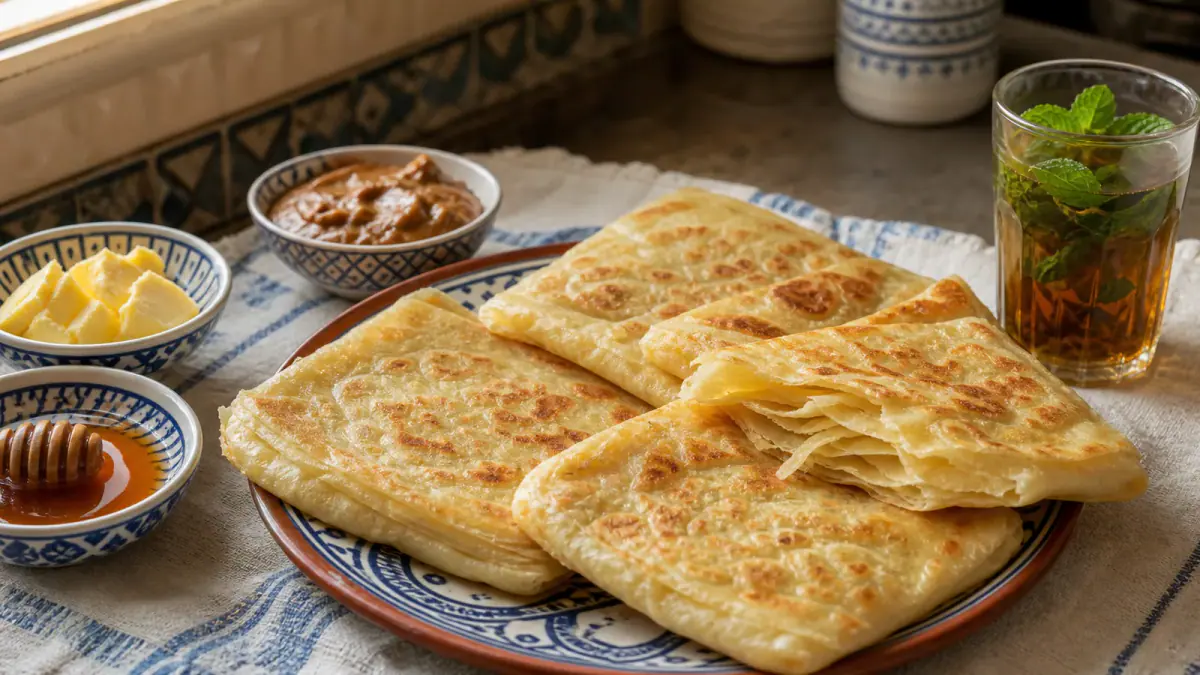
Msemen is commonly folded into a square; meloui is rolled or coiled into a round. Both belong to the family of layered Moroccan griddle breads. Their main distinction is how the stretched dough is arranged before flattening and cooking, rather than a completely separate set of ingredients.
That distinction helps when an English menu calls both “Moroccan pancakes.” Ask for the shape or name you want instead of assuming every pancake is the same preparation.
Compare the shaping
| Question | Msemen | Meloui |
|---|---|---|
| How are the layers arranged? | A thin sheet folded over itself into a square | A thin sheet rolled or coiled before flattening |
| What outline is common? | Square or rectangular | Round |
| What should you look for inside? | Thin folded layers | Rolled layers that may pull apart along the coil |
| Is the dough always identical? | No; flour ratios and leavening vary | No; the shaping does not prescribe one formula |
| Does it need an oven? | Usually cooked on a pan or griddle | Usually cooked on a pan or griddle |
What makes the square msemen?
In Christine Benlafquih’s msemen method, a very thin sheet is coated with fat and semolina, then folded in thirds in both directions. Flattening that packet gives the familiar square. Her recipe is barely leavened; other versions can be unleavened.
Our msemen recipe guide covers a yeast-free formulation and the square-fold sequence. Keep the quantities and timing of your chosen recipe together: a shaping comparison is not a reason to swap water or yeast amounts between formulas.
Cooking With Alia’s msemmen provides another square-fold example with no yeast in its ingredient list. Compare the complete method when choosing between yeast-free and barely leavened preparations.
What makes the round meloui?
Benlafquih’s meloui guide explains both a narrow-strip coil and a larger layered roll that is sliced into individual rounds. These are different ways to preserve rolled layers; there is not only one valid folding sequence.
When flattening a piece, the aim is to retain that layered structure rather than turn it into an undifferentiated disc. A round outline alone is not enough to identify meloui: batbout is another round stovetop bread, but it uses a different structure and shaping method.
Are meloui always thicker or softer?
Shape does not establish a universal texture ranking. Dough composition, the thickness before cooking and the particular shaping method all affect the result. It is more useful to compare two complete recipes than to promise that every meloui will be softer, richer or chewier than every msemen.
The two Taste of Maroc formulas themselves illustrate variation: their flour balances differ, even though both use stretched, layered dough. “They can share a dough” is therefore a better description than “their ingredients must be identical.”
Ordering and serving
Square msemen and round meloui may both be served at breakfast or tea with accompaniments such as butter, honey, jam or cheese. Toppings do not identify the bread. If a menu only says rghaif, ask whether the bread is square or round, plain or filled, and what comes with it.
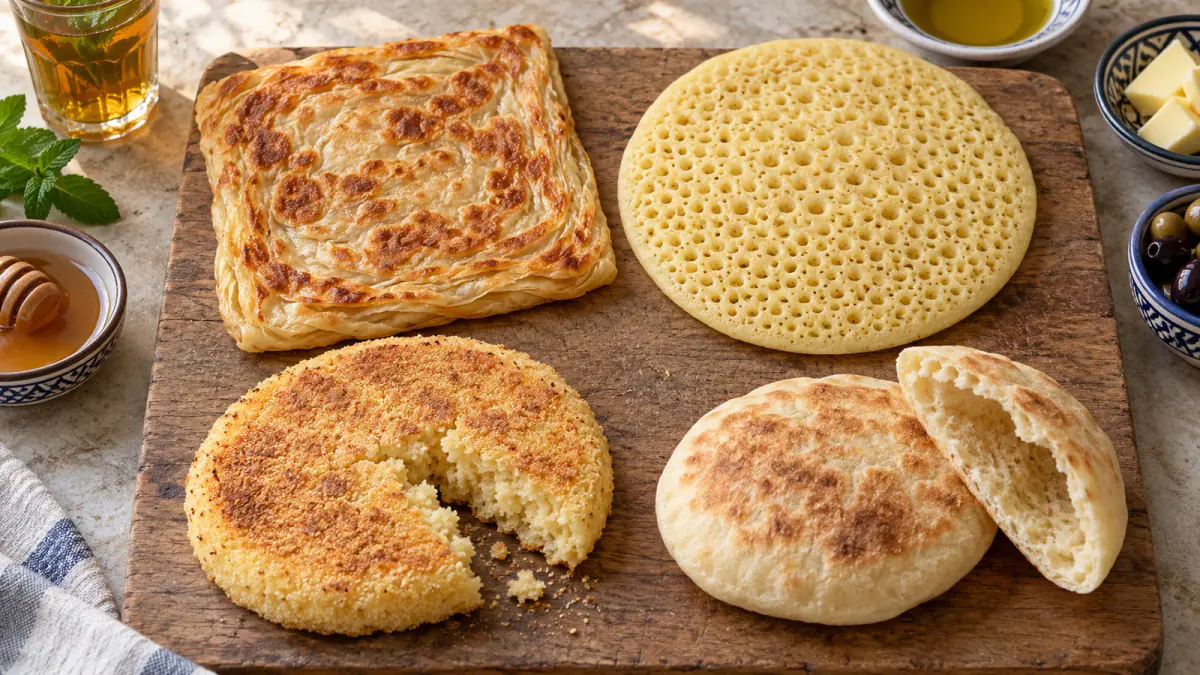
For planning a breakfast, first decide whether you want layers or a different bread texture. Our four-bread comparison contrasts msemen with porous baghrir, crumbly harcha and soft batbout. If you already have cooked msemen to keep, use the separate freezing and reheating guide.