A Moroccan breakfast is a good introduction to the country’s food: warm bread, a griddled flatbread or pancake, small accompaniments and tea or coffee. Start with msemen or harcha, add eggs or cheese if you want something savory, and try amlou when available. A generous riad spread is one version of breakfast, rather than a menu every Moroccan household follows.
This guide helps you recognize the breads, choose a manageable first order and ask useful questions before booking breakfast at your accommodation. It focuses on the morning meal; for lunch and dinner, use our separate guide to traditional Moroccan dishes.
Moroccan breakfast at a glance
| Food or drink | What to expect | A useful first pairing |
|---|---|---|
| Msemen | Square, folded flatbread with browned outer layers | Honey, cheese or amlou |
| Baghrir, also spelled beghrir | Soft semolina pancake with many little holes | Butter and honey |
| Harcha | Round semolina griddle bread with a crumbly texture | Cheese or butter |
| Khobz | The everyday Moroccan loaf, often round | Olive oil, olives or eggs |
| Amlou | Almond, culinary argan oil and honey mixture | Small pieces of warm bread |
| Eggs | Boiled, fried or prepared as an omelet, depending on the kitchen | Bread and olives |
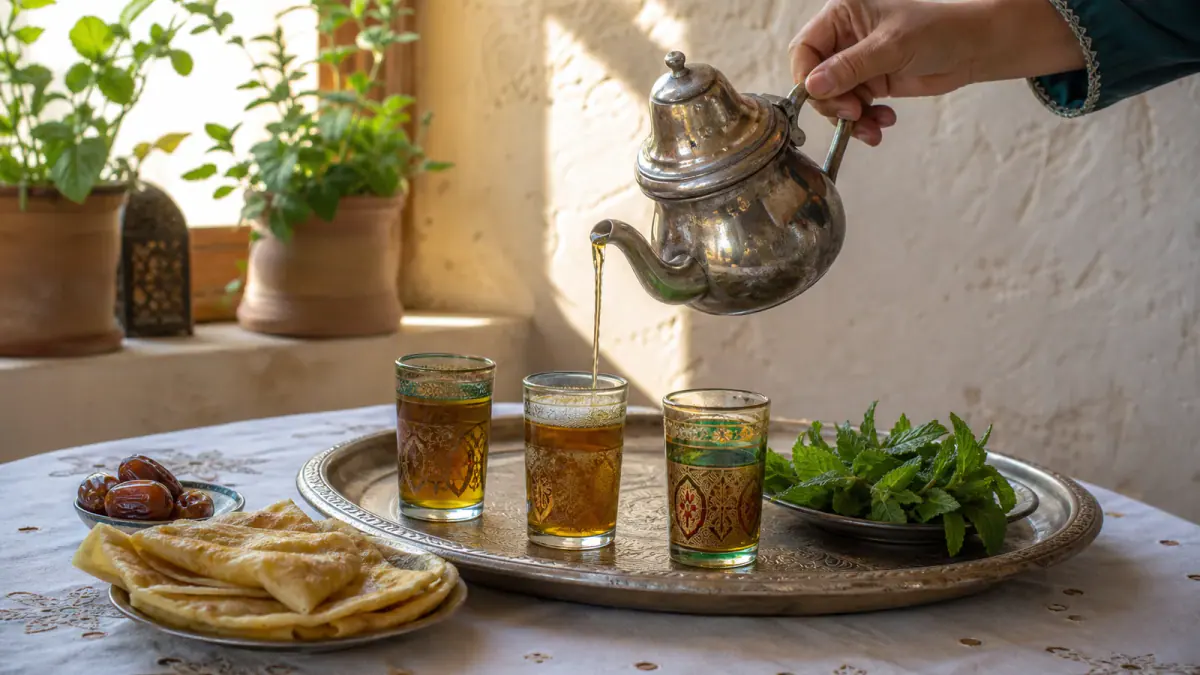
| Mint tea | Green tea with mint, often sweetened | A small breakfast or leisurely spread |
| Coffee | Preparation and milk options depend on the café | Ask before ordering if you have a preference |
Availability changes by region, kitchen and day. Ask what is fresh rather than expecting every item in the table to arrive together.
How to recognize Moroccan breakfast breads
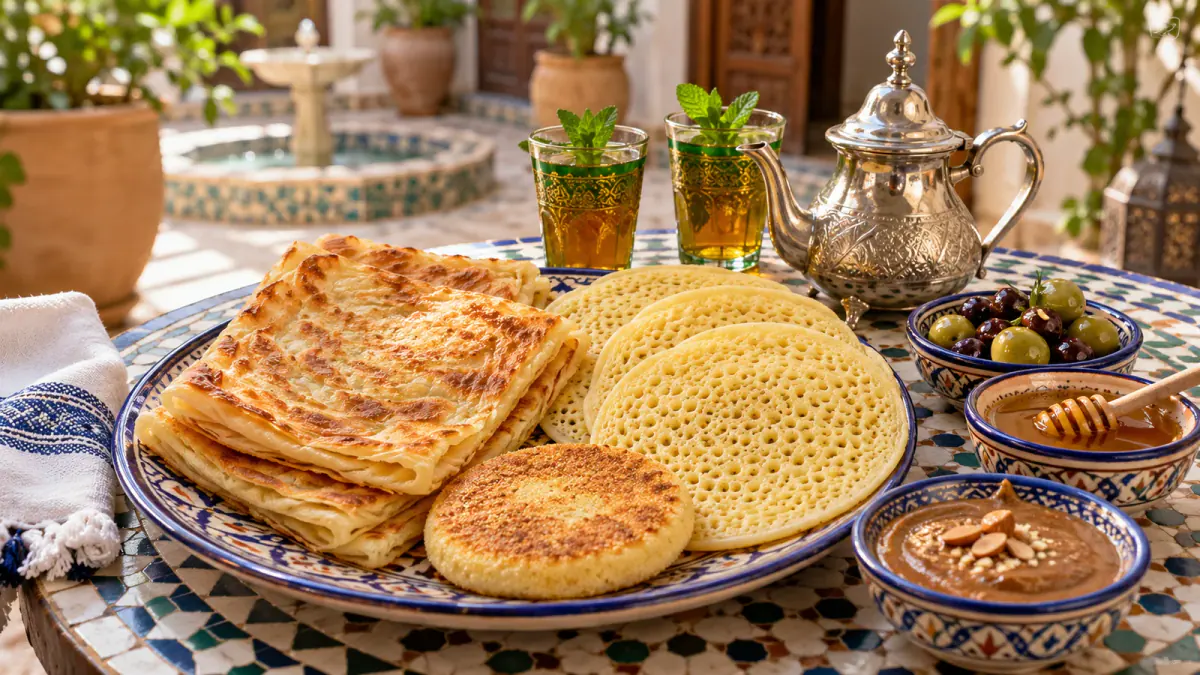
The most useful distinction is texture. Msemen has layers, baghrir has holes, harcha has a semolina crumb, and khobz has the structure of a loaf. Once you recognize these four, a breakfast counter becomes much easier to navigate.
Msemen: the square, layered flatbread
Msemen is made by stretching and folding dough with fat between the layers, then cooking it on a griddle. The outside browns while the interior stays flexible. Tear off a piece and you should see thin folds rather than a uniform cake-like crumb.
Try a plain piece first so you can taste the bread before adding honey or cheese. If a vendor offers a filled version, ask what is inside; vegetables, seasonings and other fillings change the experience substantially.
For the full preparation method, our Moroccan msemen recipe explains dough resting, folding and cooking. This breakfast guide helps you choose what to eat without repeating that recipe.
Baghrir: the pancake with little holes
Baghrir is poured from a semolina batter. Bubbles leave small holes on the upper surface, which catch a topping particularly well. It is usually cooked on one side, although regional variations exist. Christine Benlafquih’s baghrir explanation and recipe at Taste of Maroc describes its texture and the familiar butter-and-honey accompaniment.
Choose baghrir when you want something soft rather than flaky. Ask for the topping separately if you would like to try it plain or control the sweetness. A pancake already soaked in butter and honey is a different order from an unadorned one.
Harcha: the semolina griddle bread
Harcha is often round, with a grainy outer surface and a tender, crumbly middle. It may be sold as individual rounds or cut from a larger one. It can be split for a filling, but handle it gently: it does not bend like msemen.
For a simple savory breakfast, try harcha with cheese and a hot drink. Milk, butter and other ingredients vary by recipe, so the appearance alone cannot tell you whether it suits a dairy-free diet.
Khobz: everyday bread
Khobz is the general bread you will see beside many Moroccan meals. At breakfast, pieces of it can accompany olive oil, eggs or a spread. The Moroccan National Tourist Office’s food-and-drink guide identifies bread as a staple and explains its wider place at the table.
If you prefer an uncomplicated breakfast, a fresh loaf with a few accompaniments can be more satisfying than ordering every griddled bread on display. Choose the combination you actually want to eat.
Amlou, honey, olives and other accompaniments
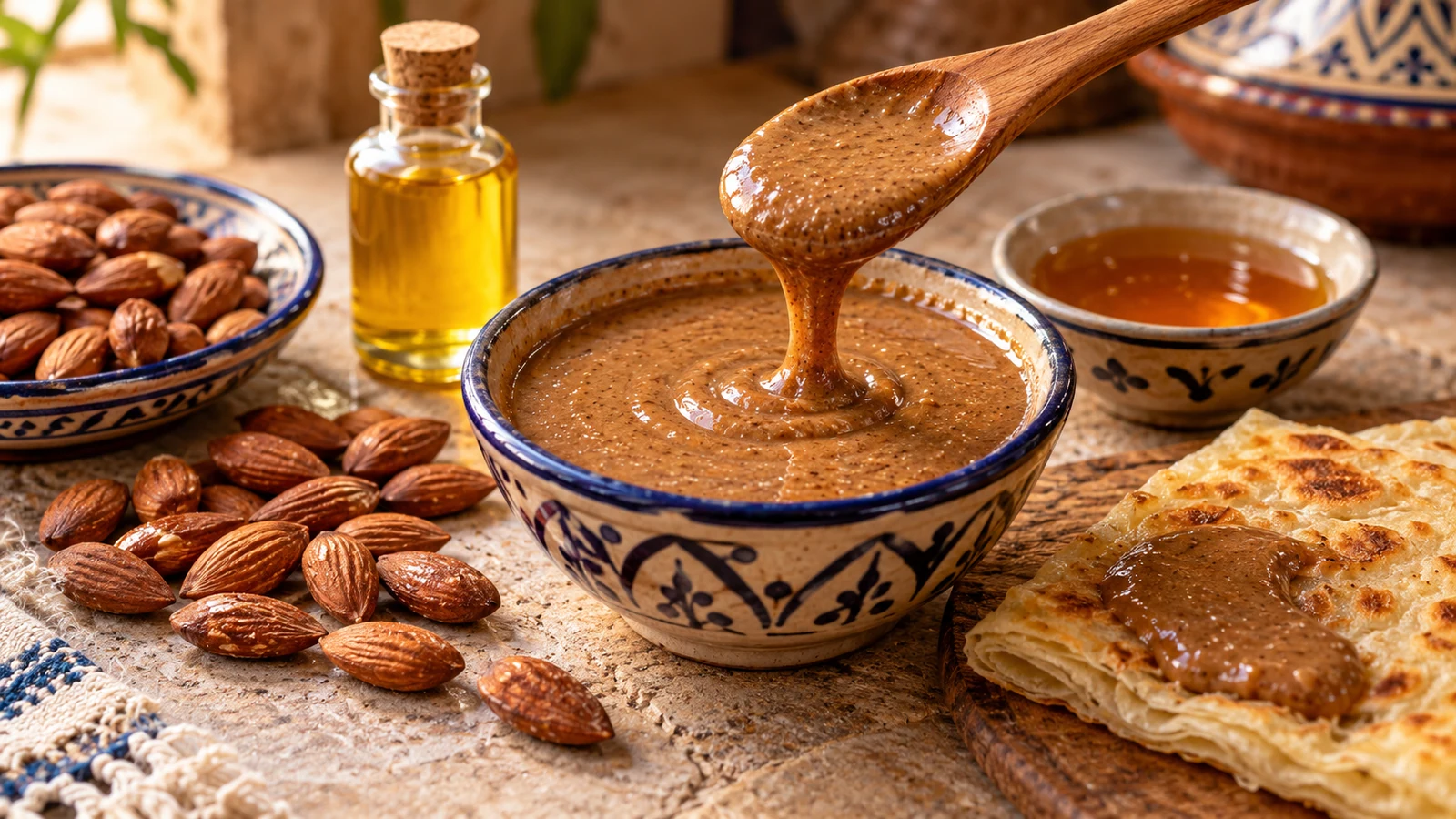
AI-generated food illustration; serving styles and textures vary.
Amlou combines ground almonds, culinary argan oil and honey. The Moroccan National Tourist Office associates it with the south and Agadir in its regional gastronomy overview. It can be loose enough for dipping or thicker for spreading.
Ask for a small bowl if you have never tasted it. Its nutty flavor is easy to miss when buried under several other sweet toppings. If you want to make it at home, our amlou recipe covers the ingredients and texture adjustments.
Other accompaniments may include butter, jam, honey, olives, olive oil or cheese. They are options rather than compulsory parts of one fixed breakfast. Try one sweet pairing and one savory pairing across different mornings instead of crowding both onto every piece of bread.
Three easy breakfasts to order
Use these combinations as starting points, then adapt to what the kitchen has ready.
| Your preference | A simple order | What to ask |
|---|---|---|
| Sweet and light | Baghrir with honey on the side and a hot drink | Is butter already included? |
| Savory and filling | Harcha or khobz with eggs, cheese or olives | Which accompaniments come with it? |
| A taste of the Souss region | Msemen or khobz with a small bowl of amlou | Does the amlou contain almonds and culinary argan oil? |
For two people, sharing one msemen and one baghrir lets you compare textures without committing to a large platter. Add more once you know the portion sizes.
You do not need a perfect phrase in Darija to order well. Pointing politely at the bread and asking for the topping separately is often clearer than an elaborate translated sentence. Confirm the drink, the number of pieces and the total before the order is prepared.
Riad breakfast, café or bakery?
Riad or guesthouse
Breakfast at your accommodation is convenient when you want to sit down before sightseeing. Check whether it is included, when service begins and whether an early departure can be accommodated. A rooftop setting does not automatically tell you how extensive the food will be.
If you have dietary requirements, contact the host before arrival. Request specific foods rather than a vague special breakfast: eggs cooked without butter, fruit, or a separate topping are easier for the kitchen to interpret.
Café or breakfast counter
A café lets you choose your own combination. Look for visible preparation, fresh turnover and a clear answer about what the menu price includes. Some orders are individual items; others are sets with bread, accompaniments and a drink.
Before ordering, check whether the price is per person, per platter or per item. A second pot of tea, juice or extra eggs may be charged separately. Prices differ enough by location and service that a universal breakfast budget would be misleading.
Bakery or takeaway stop
Takeaway suits a train morning or a quick start. Choose something manageable to carry and arrange your drink separately if needed. Sticky honey-covered pancakes are less convenient on the move than a plain bread with a topping in its own container.
If the day involves an early transfer, check opening hours the previous evening. A destination guide, such as our Agadir travel guide, can help you fit breakfast into the rest of the morning.
Tea, coffee and sweetness
Mint tea is a familiar choice, but coffee also belongs on many breakfast menus. If you prefer tea with less sugar, ask before preparation; sugar may already be mixed into the pot. Requesting it on the side is more useful than trying to remove it afterward.
For coffee, clarify whether you want it black, with milk or as a milky drink. Avoid assuming that every café uses the same names or cup sizes. Our Moroccan mint tea guide explains the preparation and serving tradition in more detail.
Dietary needs: ask about the recipe
Bread names identify a style, not a complete ingredient label.
- Gluten: msemen, harcha, baghrir and ordinary khobz typically contain wheat or semolina. Semolina is wheat, so it is not a gluten-free alternative.
- Dairy: butter, milk or cheese may be in the recipe or topping. Ask about both.
- Nuts: classic almond amlou contains almonds, and commercial variations can contain other nuts or peanuts.
- Vegan preferences: ask about butter, milk, eggs and honey individually. A plain-looking bread is not proof of a vegan recipe.
For an allergy, explain the ingredient and ask about shared utensils and preparation surfaces. If the kitchen cannot confirm, choose an option with ingredients it can establish clearly.
Frequently asked questions
What should I try for my first Moroccan breakfast?
Start with plain msemen, a small accompaniment and a hot drink. On another morning, try baghrir or harcha so you can compare the textures. Eggs or cheese make the meal more substantial if available.
Are msemen and baghrir the same?
They are different foods. Msemen is folded dough cooked on a griddle; baghrir is a poured pancake with a porous upper surface. English menus sometimes describe both as pancakes, so look at the food as well as the translation.
Is breakfast always sweet?
No. Bread with eggs, olives, cheese or olive oil gives you a savory option. Ask which items are ready rather than assuming the kitchen only offers honey and jam.
Does every riad serve amlou?
No. Breakfast contents vary. If amlou is a priority, ask your host or choose it from a menu that names it explicitly.
Does breakfast service change during Ramadan?
It can. Accommodation service and café opening hours may change, and Ramadan iftar refers to breaking the fast at sunset. Confirm morning arrangements directly instead of assuming ordinary opening hours apply.
Plan your next morning
Making the breads at home
Start with our comparison of msemen, baghrir, harcha and batbout to choose a cooking method. Then use the focused guides for baghrir without holes, harcha that crumbles or batbout that will not puff. Our semolina shopping guide helps you choose the ingredient before mixing, and the msemen freezing guide covers preparing cooked pieces ahead.
Choose one bread, one accompaniment and one drink, then add eggs or another item if you need it. Ask about freshness, ingredients and what is included before you order. That small amount of planning leaves more room to enjoy breakfast and begin your day at an easy pace.